Algora, end-to-end management for an optical store.
A custom CRM covering patients, sales, inventory, lab orders and cash closing.
- Client
- Veoptics
- Role
- Freelance Developer
- Year
- 2025
- Type
- Web app
- Duration
- 9 months
- Team
- Team of 2
- Status
- In production
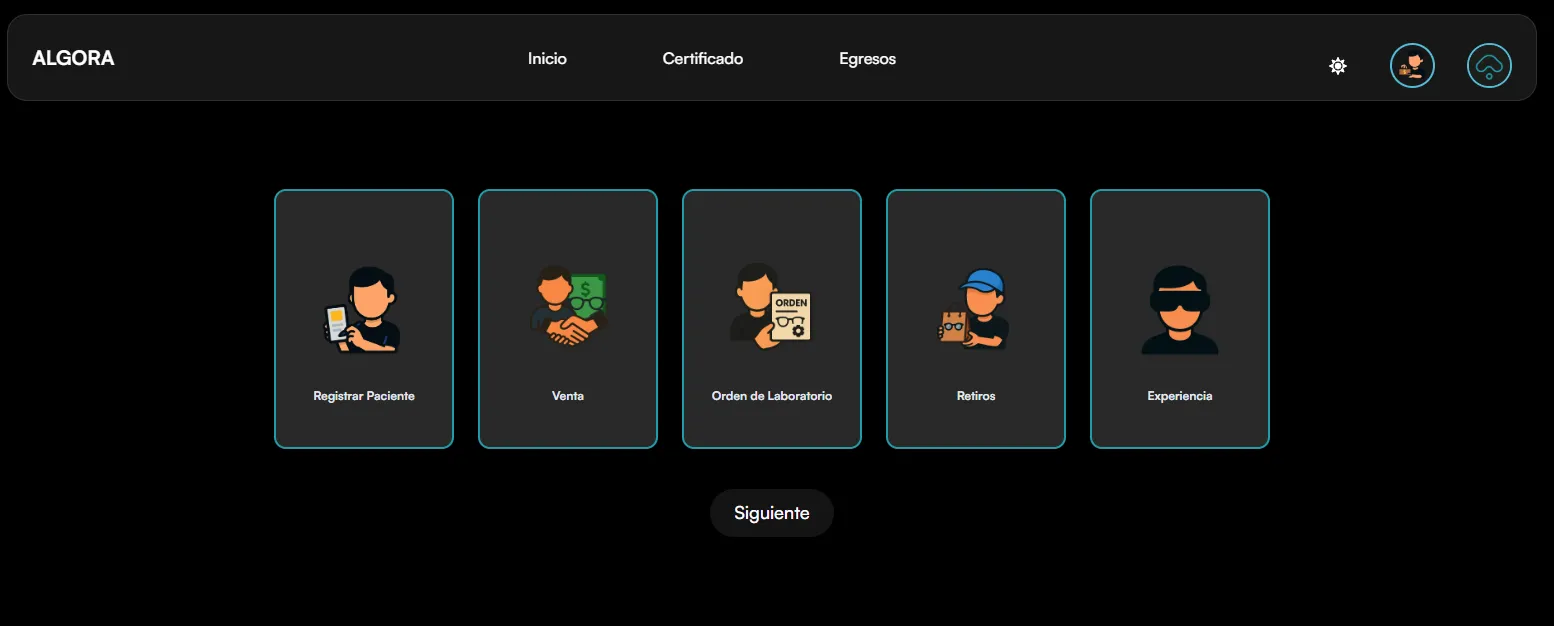
- Modules: patients, sales, lab, inventory and cash
- 5
- Tool replacing notebooks and spreadsheets
- 1
- Servers of their own to maintain
- 0
- Months working alongside the business
- 9
The problem
The store tracked patients, sales and inventory separately, and the cash register was balanced by hand at the end of each day. Finding a patient's history or knowing what was in stock took far too long.
The solution
A CRM built around the counter. Registering a patient, making a sale, creating the lab order and updating stock all happen in one flow, and the register closes with what the system has already recorded.
Context
Algora started as a freelance project for Veoptics. I handled the design and build of the React frontend, and modeled the database and backend on Supabase.
Process.
How it went from a need to a working system, phase by phase.
- (001)
Watching the counter
I spent time observing how customers were served. The system had to follow the natural order of a sale, with no extra steps while someone is waiting.
- (002)
Clickable prototype
I designed the main screens and we tested them with the staff before writing code. Several ideas changed at this stage, when changing them was cheap.
- (003)
Building by modules
Patients and sales first, then lab, inventory and cash. Each module was used in the store before the next one began.
- (004)
Data and permissions in Supabase
I modeled the database in PostgreSQL with role-based security policies, so each user reaches only what they are meant to.
- (005)
Go-live
We migrated the existing data, trained the team and fine-tuned details during the first weeks of real use.
What made the build interesting.
Supabase as the backend
Authentication, database and permissions handled without maintaining servers. For a small business, less infrastructure means fewer things that can break.
An interface with very few clicks
Large icons and guided step-by-step flows. Whoever is at the counter should not need a manual to complete a sale.
The sale drives everything else
A sale creates the lab order, updates stock and feeds the register. End-of-day closing becomes a query rather than a chore.
Security in the database
Access rules are enforced with row-level policies in PostgreSQL, so they do not depend on the frontend respecting them.
- React
- Supabase
- PostgreSQL
- JavaScript
- Tailwind
Results
- 01Sales, inventory and cash in a single tool
- 02Each patient's history available in seconds
- 03Cash closing generated from recorded sales
- 04No servers of their own to manage
Takeaways
- 01Testing a prototype with real users saves weeks of development
- 02At a counter, every extra click is felt
- 03A managed backend frees up time for what the business actually notices
Next project
UrquTrail, adventure tourism bookings